
Is It Legal to Have an Unfenced Pool in Yuma, Arizona?
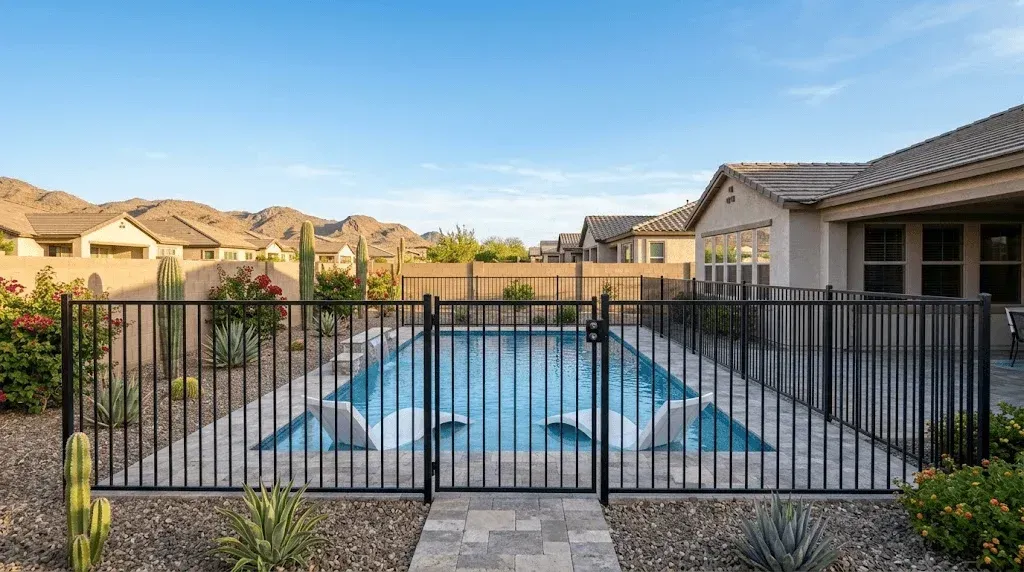
Table of Contents
- Introduction
- The short answer
- Three separate rulebooks apply to your pool
- What a compliant barrier has to address
- When the requirement actually applies to you
- Liability is a separate question from compliance
- What your insurer may require
- A fence is one layer, not the whole plan
- Why water clarity is a safety issue
- What we can and cannot help with
- Conclusion
- Ask About Equipment and Safety Add-Ons for Your Yuma Pool
- Frequently Asked Questions
Key Takeaways
- Arizona building and safety codes generally require a barrier around residential swimming pools. An unfenced pool can put a homeowner out of compliance and at greater legal risk.
- Three rulebooks can apply at once: state law, your city or county building code, and any HOA rules. The strictest one governs.
- Compliance is usually triggered by an event: building, remodeling, permitting, selling, or renting out the property.
- Liability is separate from compliance. A pool can meet code and still create exposure, because young children who enter uninvited are treated differently under the law than other trespassers.
- A barrier is one layer of protection. Safety organizations recommend several, because any single layer can fail.
Introduction
Arizona building and safety codes generally require a barrier around a residential swimming pool, so an unfenced pool in Yuma is likely to be out of compliance and is certainly a greater legal exposure. The details that decide your specific situation, including the exact dimensions a barrier must meet and whether an existing pool is grandfathered, come from the code your jurisdiction has adopted rather than from any single statewide rule of thumb. That is worth establishing before you plan anything, and it sits alongside the equipment and upkeep side of residential pool service we handle.
We are a pool service company rather than a barrier contractor or a law firm, so treat this as an orientation to the questions rather than a compliance determination. What we can do is tell you what these rules generally cover, what triggers them, and who to ask for the binding answer.
Here is how the picture breaks down.
The Short Answer
For most Yuma homeowners with a residential pool:
- A barrier is generally required, and an unfenced pool is generally non-compliant
- The governing figures come from the code your city or county has adopted, and adoption dates and local amendments vary
- Existing pools built legally under an older code may be permitted to remain, until work or a change of use brings them under current rules
- Being compliant and being safe are related but not the same, and the second is the bigger risk
- The binding answers come from the City of Yuma or Yuma County building or permit office, not from a search result
We are deliberately not printing barrier heights, gap dimensions, or gate specifications in this article. Those numbers depend on the adopted code edition, they change between editions, and publishing a stale figure on a child-safety topic would be worse than publishing nothing.
Three Separate Rulebooks Apply to Your Pool
Homeowners often assume there is one pool fence law. In practice several layers can apply simultaneously, and where they differ, the strictest one controls.
- State law. Arizona sets baseline requirements for residential pool enclosures, including conditions tied to the pool's depth and to whether young children live at the property.
- Local building code. Your city or county adopts and enforces a building code, which carries the specific barrier requirements and any local amendments. This is where the measurable numbers live, and it is the office that inspects.
- HOA rules and CC&Rs. These are private agreements, not law, but they can impose stricter requirements than code and they are enforceable against you. Some also restrict fence materials, colours, and heights, which occasionally conflicts with what code demands.
A fourth layer worth knowing about: if you rent the property out, short term or long term, additional obligations and insurance conditions typically attach. Landlord duties are not the same as owner-occupier duties.
What a Compliant Barrier Has to Address
Without giving figures, these are the categories a barrier requirement generally covers. Knowing the list makes any conversation with a contractor or inspector far more productive.
- Height, measured from the outside grade, so a barrier cannot be undermined by a slope or a raised bed
- Gaps, both underneath the barrier and between vertical members, sized so a small child cannot pass through
- Climbability, meaning no horizontal rails, decorative features, or nearby objects that create handholds and footholds on the outside face
- Gates, which typically must be self-closing and self-latching, swing away from the pool, and have the latch positioned out of a young child's reach
- Doors and windows that open directly into the pool area, which usually carry their own alarm or self-closing requirements
- Approved alternatives, such as power safety covers, which some codes accept in place of part of a barrier
- The house wall itself, which in some configurations forms part of the barrier and brings the door and window rules into play
That last point catches people out. If your pool is enclosed on one side by the house, the sliding door to the patio may itself be a regulated part of the barrier system.
When the Requirement Actually Applies to You
Codes generally are not applied retroactively to existing construction. What brings a pool under current requirements is usually an event:
- Building a new pool, which requires a permit and an inspection
- Remodeling or replastering, depending on scope
- Replacing or relocating a barrier or gate
- Selling the home, where an inspection report will flag barrier issues even where no violation exists, and it becomes a negotiation point
- Renting the property out, which changes your duties
- A complaint, since code enforcement can act on one
- Children moving in, because some requirements attach to the presence of young residents
The practical read: if you have an older unfenced pool and you are planning any work at all, ask about barrier requirements before you start rather than discovering them at inspection.
Liability Is a Separate Question From Compliance
This is the part that matters most, and it is the part code does not cover.
Under the legal principle usually called attractive nuisance, a property owner can be liable for injuries to a child who enters the property uninvited, when the property contains something likely to draw a child in and the child is too young to appreciate the danger. A swimming pool is the textbook example.
What that means in plain terms:
- "They were trespassing" is a much weaker defence when the injured person is a young child
- Meeting code does not automatically discharge the duty, though it helps considerably
- Failing to meet a known requirement is the fact pattern most likely to make a claim expensive
We are not attorneys and this is not legal advice. If you own an unfenced pool in a neighbourhood with children, a conversation with an Arizona attorney is worth more than anything you will read online, including this.
What Your Insurer May Require
Separate from law, your homeowners policy has its own terms, and pools sit near the top of most carriers' risk lists.
Things worth checking on your own policy:
- Whether the policy requires a barrier, and to what specification
- Whether an unfenced pool is grounds for exclusion, non-renewal, or a denied claim
- Whether you disclosed the pool, and whether any diving board or slide was disclosed
- What your liability limit actually is, and whether it is adequate for a pool
- Whether an umbrella policy makes sense
Call your agent and ask directly rather than assuming. A carrier's requirement can be stricter than code, and discovering the gap at claim time is the expensive way to find out.
A Fence Is One Layer, Not the Whole Plan
Safety organisations consistently recommend layers of protection rather than relying on a single barrier, because any one layer can be left open, propped, climbed, or forgotten. Commonly recommended layers include:
- A compliant barrier with a self-closing, self-latching gate
- Door and window alarms on any opening from the house to the pool area
- A gate alarm
- A surface or immersion pool alarm
- A power safety cover
- Removable mesh fencing as an additional inner barrier
- Constant, undistracted adult supervision whenever the pool is in use, with a designated watcher
- Swim lessons appropriate to age and ability
- CPR training for the adults in the household
- Keeping toys out of the pool area when it is not in use, so nothing invites a child to reach
The reason to think in layers is simple. The gate you rely on is the one that eventually gets propped open on a hot afternoon.
Why Water Clarity Is a Safety Issue
This is the point where our own work genuinely intersects with the safety question, and it gets overlooked.
Cloudy, green, or opaque water is not only a chemistry problem. It is a visibility problem:
- A child or pet in the water cannot be seen through it
- The bottom of the pool cannot be checked at a glance
- Drains and main drain covers cannot be inspected visually
- Someone in difficulty is far harder to spot quickly
In our climate, water can turn from clear to unusable in a matter of days during a heat spell or after a dust event, which is exactly why we recommend weekly or biweekly service on our FAQ page. Clear water is a genuine safety layer, not just an aesthetic one. A pool that is properly maintained is a pool where a problem is visible immediately.
What We Can and Cannot Help With
We would rather be straight about scope than imply we do everything.
What we do not do:
- Determine whether your pool complies with code. That is your building department's call
- Install fences or barriers
- Provide legal advice or insurance advice
What we do:
- Keep the water clear enough that the pool can be visually monitored at a glance
- Handle chemical balancing, equipment installation, repairs, and seasonal adjustments
- Advise on equipment and safety add-ons that support a code-compliant setup, and point you toward the right specialist for the barrier itself
- Tell you what we notice. If we are servicing a pool weekly and a gate is not latching or a cover is failing, we will say so
Across all the communities we serve, we see a lot of backyards, and the gate that no longer latches is one of the most common things we spot.
Conclusion
An unfenced residential pool in Yuma is very likely non-compliant, and it is unquestionably a larger legal and insurance exposure than a fenced one. State law, your local building code, and any HOA rules can all apply at once, with the strictest governing, and the specific requirements come from the code edition your jurisdiction has adopted.
Two things are worth doing this week if this describes your pool. Call the City of Yuma or Yuma County building office and ask what applies at your address. Then call your insurance agent and ask what your policy requires. Those two calls cost nothing and they resolve most of the uncertainty this article can only describe.
Ask About Equipment and Safety Add-Ons for Your Yuma Pool
If you are working toward a compliant, well-monitored pool setup, we are glad to talk through the equipment side and tell you what we would flag on your property. Aqua Clear Pool Services is a veteran-owned business with licensed, trained, and experienced technicians, serving Yuma,
Fortuna Foothills, Somerton, Wellton, San Luis, and Winterhaven. Call (928) 318-6640, Monday to Friday, or
request a quote. For the barrier itself and for the binding code answer, we will point you to a barrier specialist and to your building department, because those are the right people to give you a definitive answer.
Frequently Asked Questions
Do I legally need a fence around my pool in Arizona?
Generally yes. Arizona building and safety codes require a barrier around residential swimming pools, with specifics tied to depth and to whether young children live at the property. Confirm the exact requirement for your address with your city or county building office.
Is my older pool grandfathered if it has no fence?
Possibly, since codes are generally not applied retroactively. But building, remodeling, replacing a barrier, selling, or renting the property typically brings the pool under current requirements. A complaint can also prompt enforcement.
Can I be sued if a neighbour's child gets into my unfenced pool?
Yes. Under the attractive nuisance principle, a pool owner can be liable for injuries to a child who enters uninvited, because young children are not expected to appreciate the danger. Speak with an Arizona attorney about your situation.
Will a pool cover satisfy the fence requirement?
Some codes accept an approved power safety cover in place of part of a barrier, but this varies by adopted code and jurisdiction. Do not assume a cover is sufficient on its own. Confirm with your building department before relying on it.
Does my homeowners insurance require a pool fence?
It may, and a carrier's requirement can be stricter than code. Policies also vary on exclusions, disclosure, and diving boards or slides. Call your agent and ask what your specific policy requires rather than assuming code compliance is enough.