
Why Does Pool Water Turn Cloudy So Fast in Yuma's Desert Heat?
Key Takeaways
- Cloudy pool water is almost always caused by fine particles the filter has not removed yet, low sanitizer levels, unbalanced chemistry, or a combination of all three.
- Yuma's triple-digit heat destroys chlorine faster than most owners replace it, giving bacteria and early-stage algae room to cloud the water.
- Desert dust settles into pools daily, and a single haboob can overwhelm a filter that was keeping up fine the day before.
- Rapid evaporation concentrates calcium and dissolved solids, which can push water past its saturation point and turn it milky.
- Regular testing, longer filter run times, and quick action after storms or pool parties address most cloudiness before it becomes a full algae bloom.
Table of Contents
- The Short Answer: Heat, Dust, and Chemistry Working Against You
- What Cloudy Water Actually Is
- Cause 1: Chlorine Loss in Extreme Heat
- Cause 2: Desert Dust and Airborne Debris
- Cause 3: Evaporation and Mineral Buildup
- Cause 4: Swimmer Load in Peak Season
- Cause 5: Filtration That Cannot Keep Up
- How to Clear Cloudy Water and Keep It Clear
- When Cloudiness Signals a Bigger Problem
- Conclusion
Introduction
Pool water turns cloudy so fast in Yuma because the desert climate attacks water clarity from several directions at once: intense sun burns off chlorine within hours, fine dust settles into the pool daily, and rapid evaporation concentrates minerals in the water. Add heavy summer swimmer traffic, and a pool that looked clear on Friday can look milky by Sunday.
Cloudiness is more than a cosmetic issue. Hazy water usually means the sanitizer is struggling, which can make swimming less safe, and it is often the first visible stage of an algae bloom. It can also signal filter or circulation problems that get more expensive the longer they run unnoticed.
For homeowners in Yuma, understanding what drives cloudiness makes pool water maintenance far less frustrating, because you stop chasing symptoms and start addressing causes. This article walks through the five main reasons desert pools cloud up quickly and the practical steps that keep water clear.
What Cloudy Water Actually Is
Cloudy water is water full of particles too small for the eye to see individually but numerous enough to scatter light. Those particles can be dust, pollen, dead algae, sunscreen residue, calcium coming out of solution, or microscopic organic matter.
A pool stays clear when three systems work together: sanitizer kills contaminants, balanced chemistry keeps minerals dissolved, and the filter physically removes particles. When any one of those falls behind, haze appears. In Yuma's summer, all three are under stress at the same time, which is why cloudiness shows up faster here than in milder climates.
Cause 1: Chlorine Loss in Extreme Heat
Chlorine is consumed in two ways: by killing contaminants and by breaking down under ultraviolet light. Yuma gets both in extreme doses. Water temperatures in the 90s speed up chemical reactions and biological growth, while some of the most intense sunlight in the country destroys unprotected chlorine in a matter of hours.
When free chlorine drops near zero, bacteria and algae begin multiplying immediately. Long before water turns green, it turns dull and hazy. That early haze is millions of microorganisms the sanitizer did not catch.
Cyanuric acid, often called stabilizer or conditioner, acts as a sunscreen for chlorine. Too little, and chlorine disappears by midday. Too much, which builds up when chlorine tablets are the only sanitizer source, and the chlorine present becomes sluggish. Both extremes end in cloudy water, which is why testing matters more than dosing by habit.
Cause 2: Desert Dust and Airborne Debris
Yuma sits in one of the dustiest environments in the United States. Fine particles drift into pools every single day, even in calm weather. Each particle clouds the water slightly and gives algae something to feed on.
Then there are haboobs and monsoon storms, most common from late June through September. One storm can deposit more debris in an afternoon than a pool normally collects in weeks. A filter that was comfortably keeping up suddenly faces a load it cannot process quickly, and the water stays murky until the excess is skimmed, vacuumed, and filtered out.
Landscaping plays a role too. Pools near gravel yards, open desert lots, or dusty roads collect more airborne material than pools surrounded by grass or walls.
Cause 3: Evaporation and Mineral Buildup
A Yuma pool can lose a quarter inch of water or more per day in summer. The water leaves, but calcium, salts, and total dissolved solids stay behind and grow more concentrated with every top-off, because fill water in the region is already hard.
When calcium hardness climbs too high, the water cannot hold it all in solution. Calcium starts coming out as fine suspended particles, which gives water a milky, whitish look that no amount of chlorine fixes. It also scales tile lines and heater elements over time.
This type of cloudiness is chemical, not biological, so the fix is different: testing hardness and dissolved solids, adjusting pH and alkalinity, and in stubborn cases partially draining and refilling. Because draining carries risks for some pool surfaces in extreme heat, that step deserves a careful water analysis first.
Cause 4: Swimmer Load in Peak Season
Summer in Yuma means pools get used hard. Every swimmer adds sunscreen, body oils, sweat, cosmetics, and dirt to the water. Sunscreen in particular creates an oily film that clouds water and coats filter media, making the filter less effective right when it is needed most.
A single pool party can consume a pool's entire chlorine reserve overnight. The water often looks fine that evening and hazy the next morning, once the sanitizer has been exhausted and contaminants remain suspended. Testing after heavy use, rather than waiting for the next scheduled check, catches this before the haze takes hold.
Cause 5: Filtration That Cannot Keep Up
Filters remove the particles that cause cloudiness, but only while water is actually moving through them. A pump schedule that worked in March is usually too short for July. Most Yuma pools need 8 to 12 hours of daily run time in summer to turn the water over and process the constant dust load.
The filter itself matters too. A cartridge or sand bed loaded with fine dust passes particles back into the pool instead of trapping them. Rising pressure on the filter gauge, weak return jets, or water that stays hazy despite good chemistry all point toward filtration rather than chemicals. Aging pumps that have lost flow are a common hidden cause, and equipment problems tend to show up as water problems first. Owners weighing repairs against replacement can find context on the new equipment side of pool ownership before deciding.
How to Clear Cloudy Water and Keep It Clear
When cloudiness appears, the practical sequence looks like this:
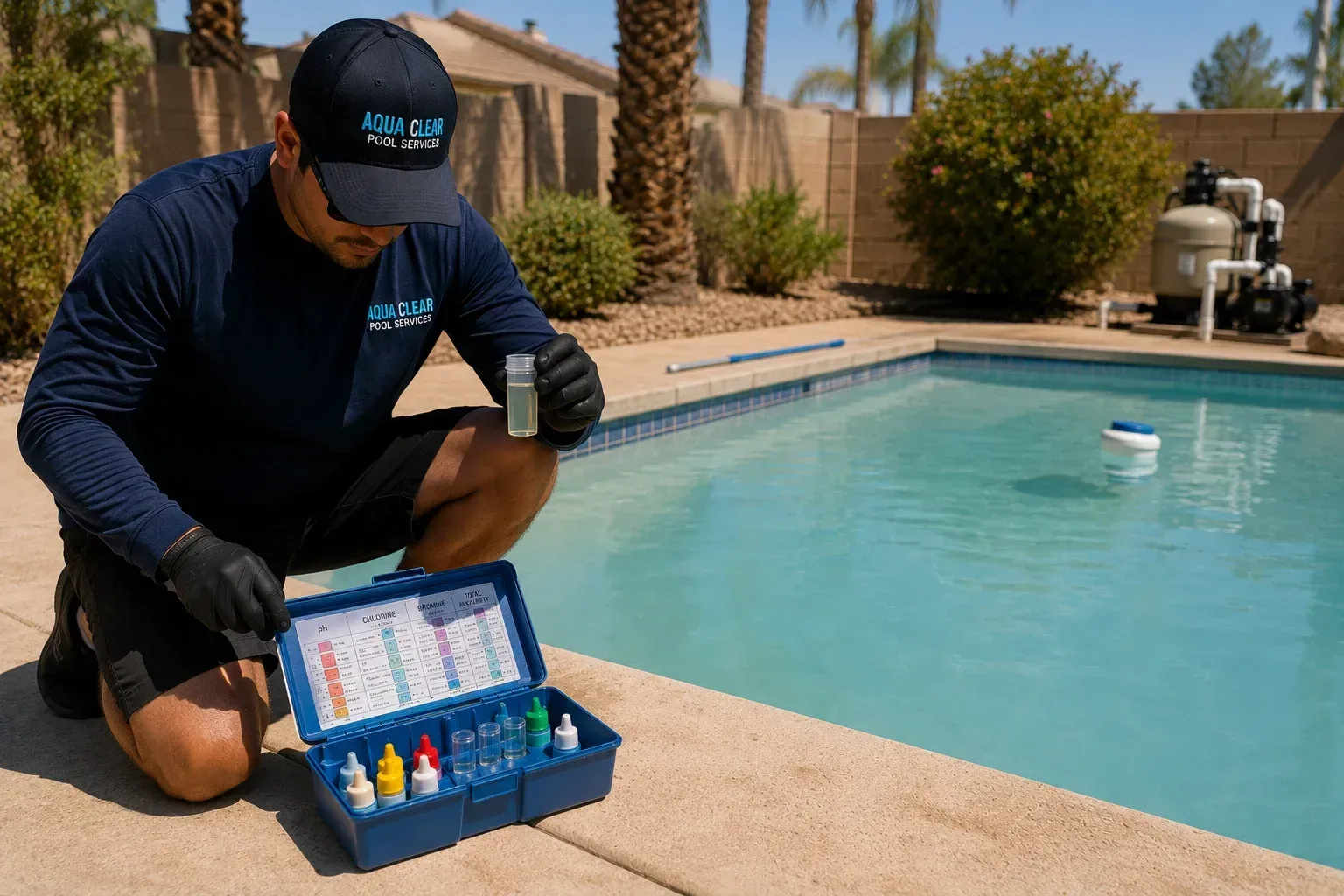
- Test first. Check free chlorine, pH, alkalinity, and stabilizer. The numbers usually reveal the cause.
- Restore sanitizer. If chlorine is low, shock the pool and keep the pump running until clarity returns.
- Run the filter longer. Continuous filtration for 24 to 48 hours clears most particle hazes.
- Brush and vacuum. Stirring settled dust off walls and floors lets the filter capture it.
- Clean the filter. Backwash sand filters or rinse cartridges once pressure rises 8 to 10 psi above clean baseline.
- Use a clarifier if needed. Clarifiers clump fine particles so the filter can catch them. They help with particle haze but do nothing for chemistry problems.
Prevention follows the same logic on a schedule: testing two to three times per week in summer, weekly brushing and vacuuming, and prompt cleanup after storms and parties. Homeowners in outlying communities deal with the same desert conditions, which is why the routine applies across the region, from central Yuma to the Fortuna Foothills area.
When Cloudiness Signals a Bigger Problem
Most cloudy water clears within a couple of days of correct treatment. When it does not, something structural is usually involved. Persistent haze despite balanced chemistry can indicate worn filter media, an undersized or failing pump, plumbing leaks pulling in air, or very high dissolved solids that only a partial drain resolves.
Recurring cloudiness on a short cycle, clearing and then returning every week or two, often points to a stabilizer problem or an algae population that was knocked down but never fully eliminated. These situations benefit from a full professional water analysis, because guessing at causes tends to waste both chemicals and time.
Conclusion
Pool water clouds quickly in Yuma because heat destroys chlorine, dust arrives daily, evaporation concentrates minerals, swimmers add contaminants, and filters run out of capacity, often all in the same week. Each cause leaves clues: biological haze follows low chlorine, milky water follows high calcium, and stubborn haze with good chemistry points at the filter.
Clear water comes from working the fundamentals consistently: frequent testing, adequate sanitizer protected by the right stabilizer level, long summer filter run times, and quick responses to storms and heavy use. Owners who understand which cause they are looking at can treat the actual problem instead of pouring chemicals at symptoms, and can judge for themselves when an issue is worth professional attention.
Tired of Guessing Why Your Pool Won't Stay Clear?
If your water keeps clouding up no matter what you try, a proper water analysis usually explains why in a few minutes. Feel free to contact us or call (928) 318-6640 with questions about your pool's water, equipment, or maintenance routine. No pressure and no obligation, just straight answers so you can decide what makes sense for your pool.
Frequently Asked Questions
Why does pool water turn cloudy overnight in Yuma?
Usually because chlorine was depleted during the day by sun and swimmers, letting contaminants build up while the pump was off. Dust settling overnight and calcium coming out of solution after a hot day are also common causes.
Is it safe to swim in cloudy pool water?
It is not recommended. Cloudiness often means low sanitizer, so bacteria may be present, and hazy water makes it harder to see swimmers below the surface, which is a drowning risk, especially for children.
Will shocking the pool fix cloudy water?
Shock helps when the cause is low chlorine or early algae growth. It will not fix cloudiness caused by high calcium, poor filtration, or suspended dust, which is why testing before treating saves time and chemicals.
How long should it take for cloudy water to clear?
With the cause corrected and the filter running continuously, most pools clear within 24 to 72 hours. Water that stays hazy longer than that usually has a chemistry or equipment issue that has not been addressed.
Does Yuma's hard water make pools cloudy?
It can. Local fill water is high in calcium, and evaporation concentrates it further. When hardness climbs too high, calcium comes out of solution as fine particles that give water a milky appearance.
Can I just use a clarifier every week to prevent cloudiness?
Clarifiers help filters trap fine particles, but they treat a symptom. Relying on them weekly usually means an underlying issue, like short filter run times or unbalanced chemistry, is going unaddressed.
Why does my pool cloud up after every dust storm?
Haboobs drop large amounts of fine dust that exceeds what the filter can process quickly. Skimming, brushing, vacuuming, and extending filter run time within a day or two of a storm helps the water recover faster.